
Tube amplifiers with an electrostatic headphone output
Electrostatic headphones need a high bias voltage and a drive signal of several hundred volts, which an ordinary headphone socket cannot supply. Tantal has a STAX-type output built in; on our other tube amplifiers and on Bellerophon an electrostatic output is fitted to order.
What an electrostatic headphone needs from an amplifier
An electrostatic headphone has no voice coil. A very thin diaphragm, held at a high, fixed bias voltage, sits between two perforated stators, and the amplifier drives the stators directly with an audio signal of several hundred volts. The load is mostly capacitive, so the output stage must deliver large voltage swings and enough current at high frequencies, where the load’s impedance falls. Tubes handle high voltages naturally, which is one reason tube designs are common among electrostatic headphone amplifiers.
The bias must match the headphone. Current STAX models use Pro bias, about 580 V, on a 5-pin socket; older models use Normal bias, about 230 V, on a 6-pin socket. Other makers have their own standards: the Sennheiser HE 90, for example, uses a plug and bias that differ from STAX. Electrostatic outputs carry dangerous voltages, so use only the correct plug and never open an amplifier with an electrostatic output yourself.
Tantal: a STAX-type output built in
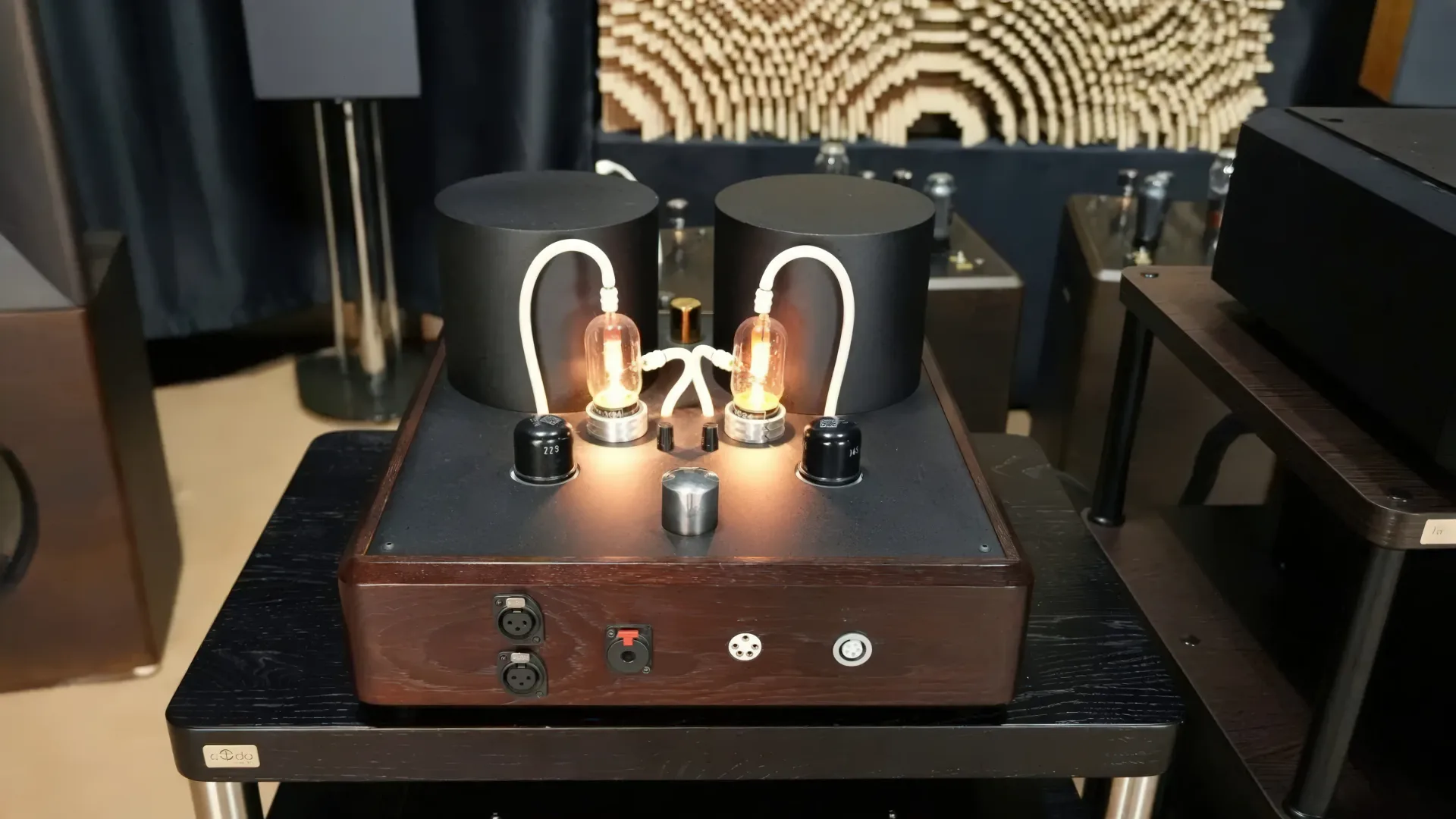
Tantal runs two 3C24 triodes with tantalum anodes in pure Class A, 3 W per channel into 8 Ω. Beside the 6.3 mm and 4-pin XLR headphone sockets it carries a STAX-type output (labelled E-Static) as standard, so one chassis drives electrostatic, planar and dynamic headphones, as well as sensitive loudspeakers.
The input stage uses 6Zh4 tubes, and two 6D22S kenotrons rectify the supply. Owners have written about Tantal with the STAX SR-007 and SR-009 and the Sennheiser HE 90: see owners on Tantal with electrostatic headphones. A push-pull build is available to order. For Tantal next to two dedicated electrostatic amplifiers, the STAX SRM-T8000 and the HeadAmp Blue Hawaii SE, see Tantal, SRM-T8000 and Blue Hawaii SE side by side.
Other models: an electrostatic output to order
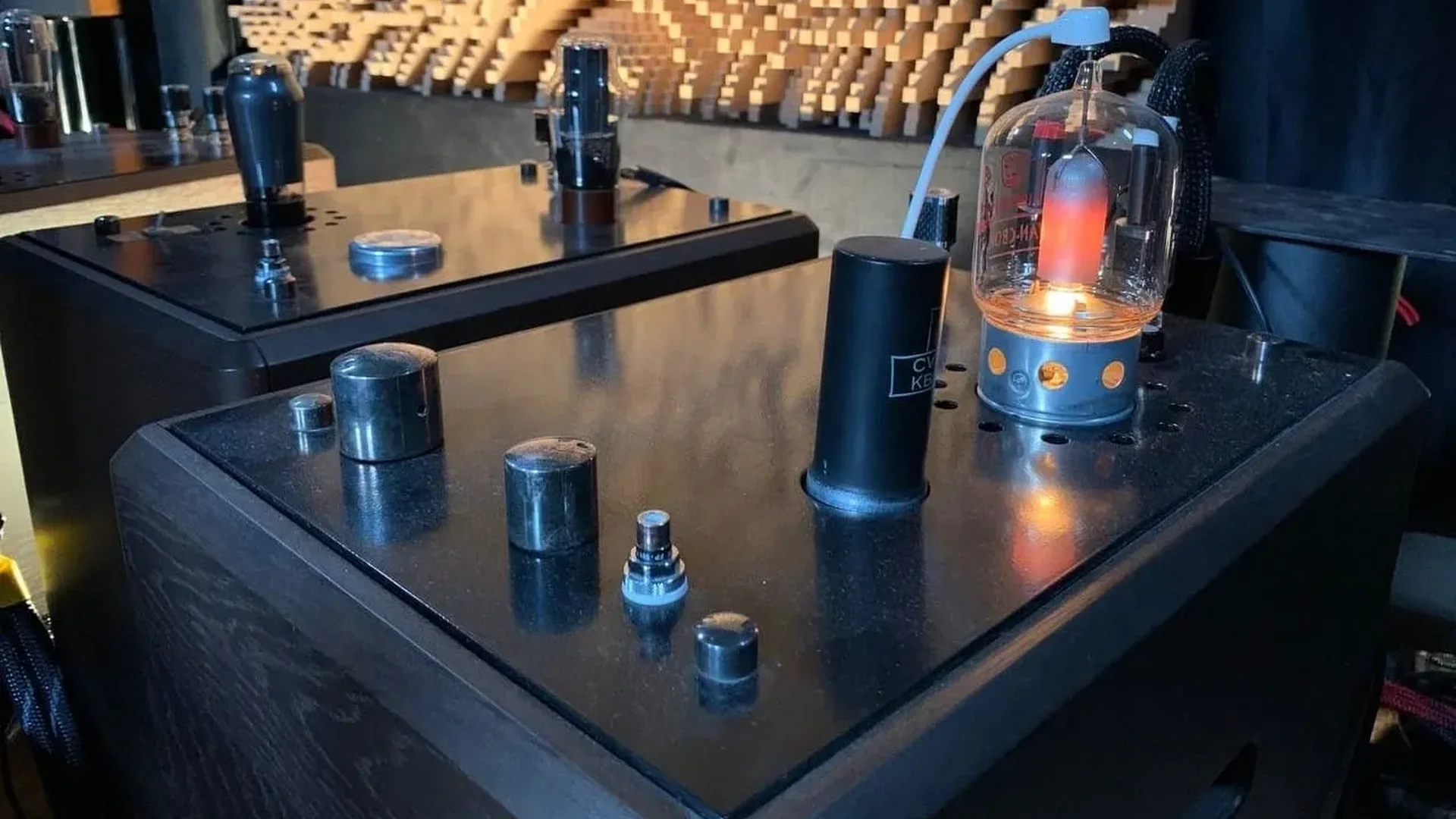
On our other tube amplifiers an electrostatic output is an option, agreed before the build starts: Solaria (45 triodes, 2 W), Eurybia (2A3, 2 W), Atlas (300B, 5 W), Helios MkII (G-811, 15 W), Endymion (845, 211 or 805, 15–25 W) and Ether (GM-70 Triode / GK-71 Pentode, 25 W). Tantal Senior, on 4E27 tantalum-anode pentodes at 30 W, takes a STAX-type output to order.
The solid-state Bellerophon, a Class AB amplifier with a built-in DAC, can also be fitted with an electrostatic output. Hades, our Class D model, has no electrostatic option. All the amplifiers with a headphone output are compared on the headphone amplifiers page.


Which headphones connect, and how
The table lists only headphones that owners have used with Demograf Audio amplifiers and written about; connection details go no further than those reports and the published standards. Owner report: the HE 90 on a G-811 amplifier.
Tell us your headphones and we will confirm the connection before the build.
| Headphones | Connection | Demograf Audio amplifier |
|---|---|---|
| STAX SR-007 | STAX Pro bias (about 580 V), 5-pin socket | Tantal (built in); other models to order |
| STAX SR-009 | STAX Pro bias (about 580 V), 5-pin socket | Tantal (built in); other models to order |
| Sennheiser HE 90 | Its own plug and bias, different from STAX | Tantal, without an adapter |
Rubedo: an AL4 electrostatic amplifier in the archive
Rubedo was a dedicated push-pull amplifier for electrostatic headphones on vintage AL4 tubes, with Tango transformers, Jensen capacitors and silver AMRG resistors, and an external power supply with kenotron rectifiers. It is an archive piece and is not offered for sale.
The archive entry documents it inside and out, together with a collector’s review first published in 2014. The reviewer set Rubedo and a later tantalum-anode design, the forerunner of Tantal, against other electrostatic amplifiers, using the STAX SR-009, SR-007 Mk2 and SR-Omega and the Sennheiser HE 90, and described Rubedo’s sound as rich, warm and analogue. It is one listener’s subjective view in the reviewer’s own system, not a measurement.
Ordering and warranty
Every amplifier is made in Kazakhstan by Dmitriy Gubchenko, who leads the design and voicing. Each unit is made to order with its own measurement report; the outputs, including the electrostatic socket, are agreed before the build starts, and a build takes six months or longer. Every unit carries a one-year warranty on materials and workmanship, with extra warranty of +1 or +2 years available. How to order.