
Review · Published 2026-10-18
Tantal headphone output measured by Reference Audio Analyzer
Reference Audio Analyzer (RAA), a website that measures headphones, amplifiers and other audio equipment on its own test bench, has published a full headphone-output report on a Tantal amplifier by Demograf Audio. Measurements answer different questions from listening impressions, and this report shows both what the headphone output does well and where it has limits. Below we set out RAA’s main figures, what they mean in practice, and which headphones they suggest for this output.
The measurements are RAA’s; the reading of them is ours. RAA labels the unit “DIY Tantal” under the maker Demograf. Its report does not say when the unit was built, which revision it is or how it was configured, so we cannot confirm that it matches the Tantal in today’s catalogue. RAA tested the unbalanced headphone output only; the electrostatic and loudspeaker outputs were not measured.
What RAA measured
RAA tests every amplifier as a “black box”, without regard to price or reputation. Its headphone-amplifier set covers frequency response and output impedance, the voltage and current available into loads from 16 Ω to 763 Ω, the change in frequency response with resistive loads and with real headphones, crosstalk between channels, and distortion at a range of output levels. The full report, with every graph and spectrum, is on RAA’s website.
Key figures
| Parameter | RAA’s result |
|---|---|
| Output impedance, average 40 Hz–15 kHz | 36.7 Ω (left 35.8 Ω, right 37.6 Ω; from about 21 Ω to 42 Ω across the band) |
| Maximum output voltage | 7.2 V RMS (17.2 dBV) |
| Output current, linear / maximum | 84.4 mA / 130.6 mA |
| Frequency response without load, 40 Hz–15 kHz | −5.6 to +0.9 dB (left), −6.2 to +1.0 dB (right) |
| Crosstalk at 1 kHz | −25 to −34 dB, depending on the load |
Frequency response and output impedance
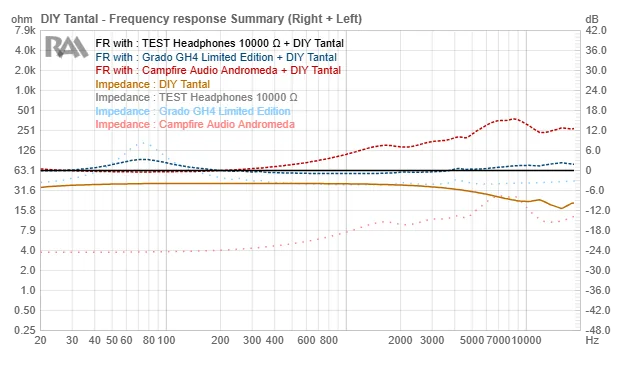
Without a load, the response is flat through the midrange. It falls gently in the deep bass and by several dB above about 7 kHz, with its lowest point near 12 kHz. RAA’s 40 Hz–15 kHz figure for this is −5.6 to +0.9 dB.
The more important number for headphones is the output impedance. At an average of 36.7 Ω it is high, as is common for tube output stages, and far higher than the fraction of an ohm many solid-state headphone amplifiers have. A headphone amplifier’s output impedance and the headphone’s own impedance form a voltage divider, so the response the listener hears depends on the headphones plugged in.
How the response changes with the headphones
Headphones with a flat impedance
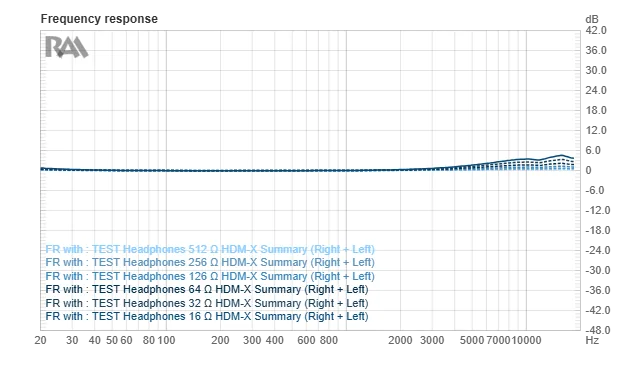
Planar magnetic headphones and many in-ear models with a single dynamic driver have an impedance that is nearly constant with frequency. RAA simulates them with resistive loads. The lower the load, the more the response changes, mainly as a rise in the treble:
- 16 Ω: 4.5 dB deviation from the unloaded response;
- 32 Ω: 3.3 dB;
- 64 Ω: 2.1 dB;
- 126 Ω: 1.3 dB;
- 256 Ω: 0.7 dB;
- 512 Ω: 0.4 dB.
Dynamic headphones
A dynamic headphone’s impedance usually peaks at its bass resonance. With the Grado GH4, which RAA uses because its resonance is pronounced, the response deviates by 4.3 dB, as a lift around that resonance. High-impedance dynamic headphones, of 250 Ω and more, have the smallest share of this effect, as the resistive tests above show.
Balanced-armature in-ear monitors
Multi-driver in-ear monitors are where the output impedance matters most, because their impedance swings widely with frequency. With the Campfire Audio Andromeda the response deviates by about 16 dB, as a large rise in the upper treble; with the Fearless Audio S8F Freedom, by about 9 dB. In plain terms, this output changes the tuning of such monitors substantially.
RAA does not call such changes a defect. In its words, a change in frequency response with the headphones is a matter of taste, like extra equalisation or a tone adjustment that either evens out or colours the final sound of the headphones.
Voltage and current
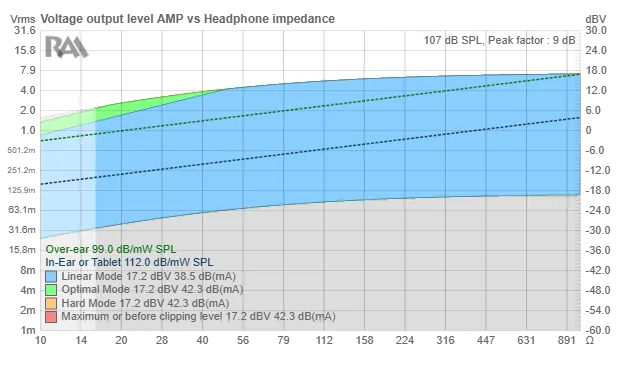
The output reaches 7.2 V RMS into high impedances. Into low impedances it is limited by current, about 84 mA in its linear range, so the voltage available falls as the load goes down. On RAA’s voltage-versus-load graph, the amplifier still reaches RAA’s reference loudness for typical full-size headphones and for in-ear models at every load from 16 Ω up. For high-impedance headphones, which need voltage more than current, 7.2 V leaves a generous margin.
Crosstalk
At 1 kHz, the signal leaking from one channel into the other is 25 to 34 dB below the signal itself, depending on the load. RAA treats values worse than −40 dB as audible in the stereo image, which then moves towards mono or, the more common case, widens and blurs the placement of sources. Crosstalk here also rises steadily with frequency, and in the top octave it comes within a few dB of the signal. RAA’s phase graph puts most of the treble crosstalk close to the out-of-phase zone, which it associates with a wider, less sharply focused stage rather than a narrower one.
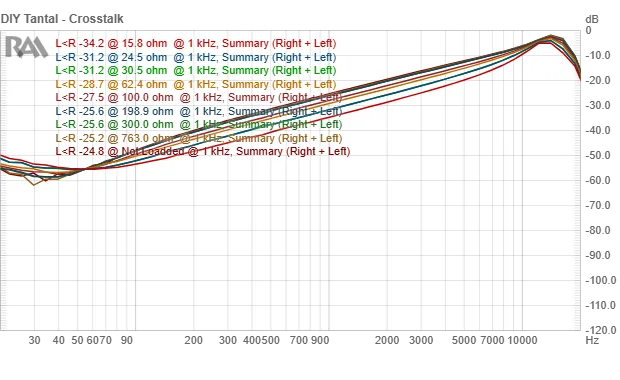
RAA adds two cautions. A rise at high frequencies usually points to capacitance in the headphone socket’s contacts, and crosstalk depends heavily on the contact resistance, the headphone cable and the impedances involved, so the graph gives only a general picture.
Distortion
RAA publishes distortion against output level for nine loads, with harmonic spectra and intermodulation tests, but gives no single summary figure for this unit. As is typical of tube output stages, its graphs show distortion rising with level towards full output. We do not reproduce those graphs here; they are in the full report.
What the measurements mean in practice
- High-impedance dynamic headphones (roughly 250 Ω and above) are the natural match: the response changes by less than 1 dB, and the voltage is ample.
- Low-impedance planar and dynamic headphones will play loudly enough, with a treble lift of a few dB that depends on their impedance.
- Multi-armature in-ear monitors are a poor match if you want to hear them as their makers tuned them.
- Stereo image: the measured crosstalk is above the −40 dB level that RAA treats as audible, which it associates with a wider, less precisely focused stage.
As RAA puts it in its report, a device is best judged not in absolute terms but as a whole, together with the headphones and the conditions it is used in. Owners’ impressions of Tantal with electrostatic, planar and dynamic headphones are collected in Tantal 3C24 amplifier with electrostatic headphones: owners’ review and Tantal compared: Viva Solista, Sennheiser HEV 90 and the AL4 Rubedo.
Summary
RAA’s measurements describe a classic tube headphone output: an output impedance of about 37 Ω, 7.2 V into high impedances, a response that depends on the headphones plugged in, and crosstalk above RAA’s −40 dB threshold, rising towards the treble. Paired with high-impedance dynamic headphones it behaves almost as a neutral source; with low-impedance and especially multi-armature in-ear monitors it changes their sound audibly, which RAA itself counts as a matter of taste. The measured unit’s exact identity is not stated in the report.
Which Demograf Audio piece fits
Tantal is a Class A amplifier on 3C24 tantalum-anode triodes, 3 W per channel, with 6.3 mm and 4-pin XLR headphone outputs, a built-in STAX-type output for electrostatic headphones such as the STAX SR-007 and SR-009, and loudspeaker outputs. If you plan to use low-impedance or multi-armature in-ear monitors, tell us before the build, so that we can discuss the pairing. Our guide to amplifiers for headphones and loudspeakers explains what each kind of headphone needs from an amplifier.
Every Tantal is made to order by Dmitriy Gubchenko and covered by a one-year warranty (extra warranty available: +1 or +2 years). Each unit ships with its own measurement report.